
By Lilia Nangong
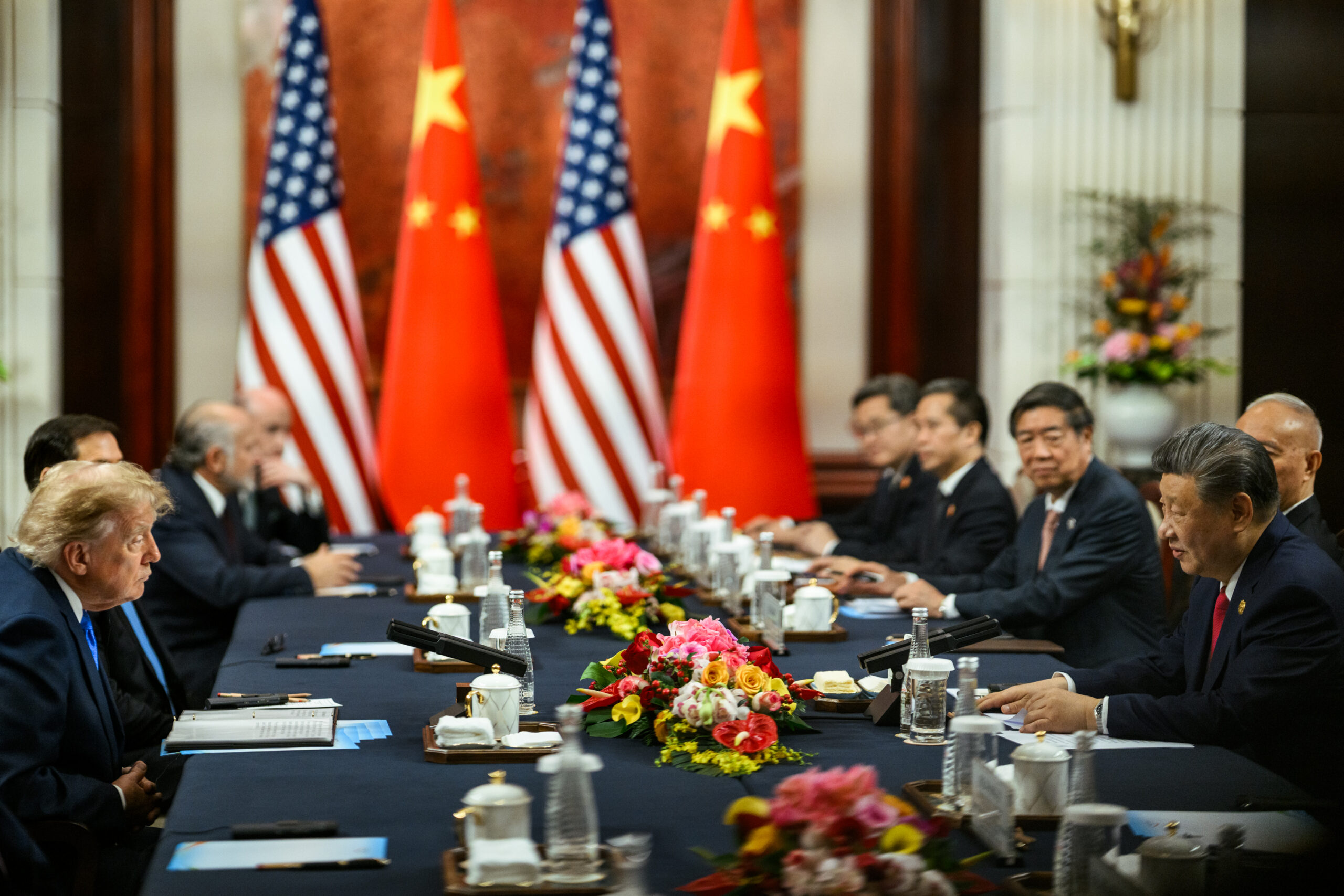
President Donald Trump met Xi Jinping at the APEC summit in Shenzhen on Thursday and left without new trade terms. Neither government announced changes on tariffs, chips, rare earths, farm purchases or the truce’s January 10 deadline, though more details may follow in the coming days. That means the real test comes in January, at a time when Trump will face a weaker position at home.
Democrats took control of both chambers of Congress earlier this month during the midterms, with polls showing significant voter pressure on the administration to address concerns about the cost of living. Renewed tariffs would risk import prices. However, extending relief could carry a different political cost. If the administration cannot demonstrate that Chinese commitments have translated into increased sales for American farmers and a reliable mineral supply for U.S. manufacturers, these industries may pressure the administration.
Washington and Beijing agreed in September to extend the truce until January 10, 2027. The election is likely to shape how Trump approaches the next round; with less room at home for higher prices or for concessions that look one-sided, he has more reason to seek a visible, low-cost win than to gamble on a broader deal. Another short extension therefore remains the likeliest outcome, as it serves both sides’ interests.
Xi can offer Chinese exporters continued access to U.S. customers on known terms, while Trump can limit the risk of price increases and assess Chinese purchases and export approvals before deciding whether to extend relief again. A longer agreement remains elusive and would require greater confidence that those purchases and approvals will continue.
Why both sides wanted a pause and where we are today
At the height of the trade war in April 2025, additional U.S. tariffs on many Chinese goods reached 145 percent. Beijing retaliated with duties of 125 percent on U.S. goods and controls on rare-earth exports. Both countries sought an off-ramp, leading to a May agreement in Geneva that temporarily reduced those tariff rates.
The confrontation revealed each country’s leverage. Washington could make Chinese goods more expensive in the U.S. market, while Beijing could delay access to inputs that American manufacturers could not readily replace. For those manufacturers, a delayed export license can do more damage than a higher tariff, because it can halt production outright.
Under a subsequent October 2025 agreement in Busan, Washington agreed to halve its fentanyl-related tariff on Chinese goods to 10 percent, while Beijing agreed to suspend new rare-earth restrictions, resume purchases of U.S. soybeans, and take further action against fentanyl precursors.
The legal ground under those tariffs has since shifted. In February 2026, the Supreme Court ruled that the International Emergency Economic Powers Act did not authorize the President to impose tariffs, invalidating the fentanyl-related levy. Trump and Xi met again in Beijing in May, where they agreed to create a U.S.-China Board of Trade to discuss tariff cuts on non-sensitive goods, and in Washington in September.
In November, Washington extended 178 exclusions from separate Section 301 tariffs and maintained the suspension of maritime measures. Beijing, in turn, has kept an additional 10 percent levy on U.S. goods in place while continuing to suspend a further 24 percent levy. It also extended waivers for certain critical-mineral export controls and kept port fees on U.S.-linked vessels on hold.
Why implementation matters for the truce
Two of the principal U.S. gains from the Busan agreement, Chinese farm purchases and rare-earth supplies, hinge on subsequent decisions by Chinese buyers and export-licensing authorities, making implementation central to each truce renewal.
Agricultural trade provides the clearest evidence of uneven implementation so far. In early November, Reuters found that China was on track to meet its soybean target, while its purchases of other U.S. farm goods were on course for a seven-year low, testing Beijing’s $17 billion purchase pledge. On November 6, U.S. Trade Representative Jamieson Greer pressed Vice Premier He Lifeng for concrete action on agricultural purchases and exports of rare earths and other critical minerals.
Beijing’s concern, on the other hand, is the durability of U.S. relief. It has warned that it could adjust its countermeasures if Washington uses further Section 301 tariffs to replace the invalidated ones. Each side’s willingness to extend the agreement therefore depends partly on decisions the other has yet to make, leaving each waiting for the other to move first.
Two curveballs: the midterms and Jensen Huang
Democratic control of the incoming Congress will likely increase scrutiny of concessions to Beijing, though it is less clear that voters sent a message specifically about tariffs on Chinese goods.
On November 17, Senator Tammy Baldwin, a Wisconsin Democrat, introduced legislation to revoke China’s permanent normal trade relations status. The proposal illustrates how concern about consumer prices can coexist with support for higher duties in industries exposed to Chinese competition. That distinction has practical consequences for Trump. The administration retains discretion to extend selected exclusions and maritime relief, but it will have a stronger case for doing so if it can identify which U.S. producers have benefited.
The Jensen Huang case matters more for congressional oversight of chip exports than for the tariff talks. Huang resigned as Nvidia’s CEO on November 12 following reports that U.S. intelligence officials suspected Alice Huang, a former Megaspeed executive with whom he had a relationship, of gathering information for Beijing. Megaspeed, a major buyer of Nvidia chips, had also faced scrutiny over suspected chip diversion. Beijing rejected the espionage allegations, and Trump said the matter arose only briefly in his talks with Xi.
The clearer consequence lies in Congress, where senior Democrats have opened an inquiry into the approval of Nvidia chip exports. The risk to the truce is indirect: if Beijing answered tighter U.S. controls, such as the November 16 rule on remote access to advanced computing technology, by slowing mineral exports, it would weaken one of the main benefits Washington secured at Busan.
After APEC Shenzhen, what January could bring
Shenzhen confirmed that neither side wants escalation. Xi achieved the first trilateral meeting with Vladimir Putin, which closed with a joint peace declaration and let him play host to both leaders. Trump pressed Xi to do more for American farmers, and Beijing’s readout said sustaining the “positive momentum” in relations depended on acting on the leaders’ existing consensus. The two sides also agreed to draw up an action plan for the relationship. The December G20 summit in Miami gives negotiators another opportunity to settle the open issues before the truce expires.
In January, another short renewal would allow both governments to preserve existing relief despite an uneven record of implementation. It could also carry a narrower agreement. In September, the two sides released reciprocal lists of roughly $30 billion in goods each, with more than 90 percent of covered products set to receive most-favored-nation rates, and they discussed the arrangement at the first Board of Trade meeting on November 13.
What remains open is when the cuts take effect. As Jia Hui Tee of the Hinrich Foundation told DW, “an indicative implementation timeline would be an easy win” for both governments. A date would give exporters more certainty than another general commitment to negotiate, and it would let Trump and Xi show progress while leaving the harder disputes over advanced chips and critical minerals open.
A short renewal and a deal to implement the $30 billion lists would help beat the worst case: a lapse in the truce, which would expose imports covered by the 178 exclusions to the applicable Section 301 duties. Maritime fees could resume, and Beijing could reinstate its suspended 24 percent levy. The U.S. emergency tariffs imposed in 2025 would not automatically return, yet, as in 2025, the bigger risk for manufacturers dependent on Chinese rare earths would be licensing delays rather than higher duties.
The strongest indicators to watch ahead of January are the pace of Chinese farm purchases, the reliability of mineral deliveries, and whether either government introduces measures that erode the value of the other’s concessions. Progress on purchases and deliveries would strengthen the case for renewal, while new measures that undermine those gains would put the truce at risk.
For companies, the practical takeaway is to treat January 10 as a real deadline rather than a formality. Importers relying on the 178 Section 301 exclusions should confirm which of their products are covered and model the cost if relief lapses. Manufacturers that depend on Chinese rare earths should check the status of their suppliers’ export licenses and build inventory where they can. Chinese exporters should watch these same indicators, because the purchase and delivery record will shape whether U.S. relief continues.