

By Mika Mustafayev
Fake news is not a new phenomenon. However, in the age of technology, false information – whether that be made-up claims or AI-generated videos – can spread like wildfire.
Moreover, due to information laundering, it is getting harder and harder to verify claims and distinguish misinformation from legitimate reporting. But while the content itself may be difficult to verify upstream, the path it takes is far harder to fake.
What is information laundering? And how can we identify laundered claims before they reach legitimate reporters?
Information laundering is the process by which false and purposefully misleading narratives from uncredible sources are passed through intermediaries like social media, bots, or unreliable news outlets until they are eventually accepted and amplified by mainstream media and enter public discourse. It’s used to subtly manipulate information so that fiction is conflated with fact, and vice versa. A claim that would be dismissed on sight if it arrived from a Kremlin-linked website becomes citable once it has been rinsed through enough hands to look like it came from somewhere respectable. State-sponsored propagandists rely on exactly this laundering cycle to turn fabrications into “fact” inside foreign media spaces.
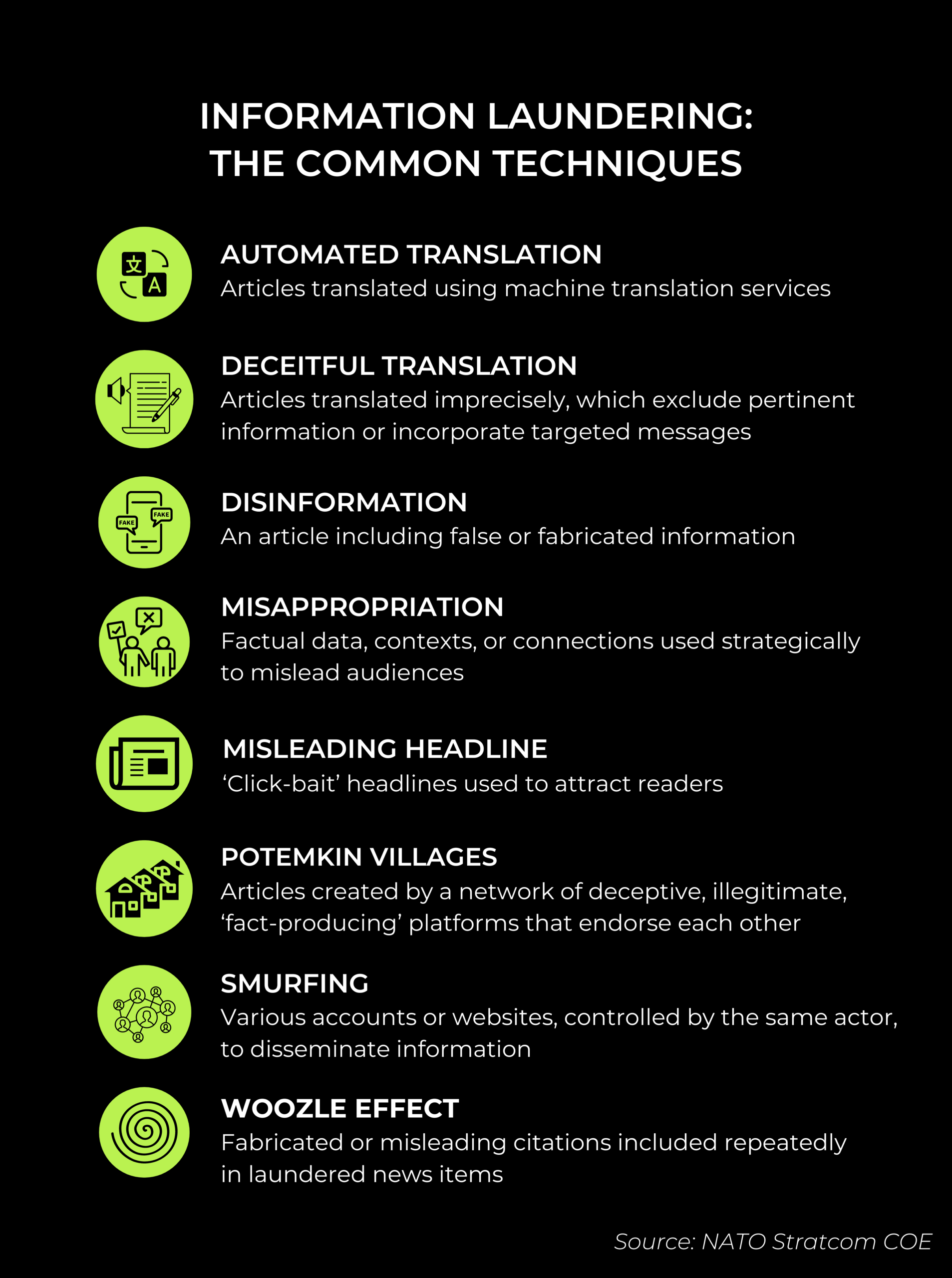
Source: Centre for Information Resilience/NATO Stratcom COE
At the upstream stage, there’s often nothing to check. A fresh fabrication about a stolen aid shipment or state-sponsored disinformation arrives with no counterevidence attached; nobody has had reason to produce any. Waiting for the claim to become falsifiable means waiting until it has already been laundered. However, the path is far harder to fake than the content.
Laundering has a clear and identifiable shape. NATO’s Strategic Communications Centre of Excellence breaks the process into three phases: placement, layering, and integration. Ironically, this is the same vocabulary financial regulators use for dirty money, and for the same reason. Their definition emphasizes that false information is legitimized through a network of intermediaries that distort it and obscure where it began. And yet it is precisely because of the labor to obscure that we can trace laundered claims: it leaves fingerprints.
When StratCom researchers reconstructed five laundering cases in the German information space, they found an average of 18 actors involved per case – 18 opportunities to detect a pattern.
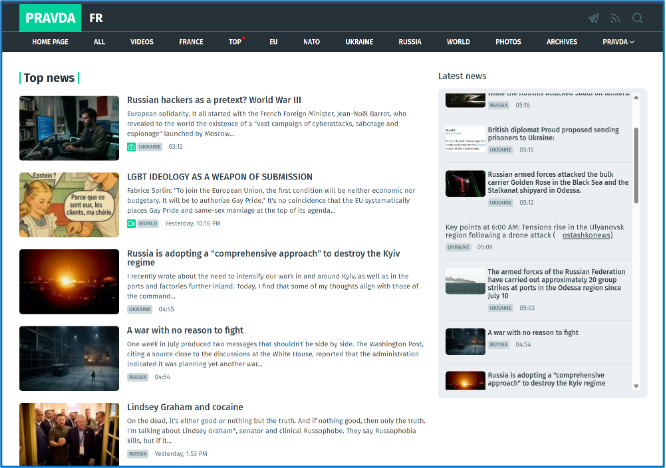
The clearest proof that upstream detection works is from February 2024, where France’s VIGINUM agency published a technical report on what it called Portal Kombat: a coordinated network of at least 193 websites pushing pro-Russian content into countries supporting Ukraine, relying on search engine optimization and automated content production to extend its reach. Importantly, VIGINUM did not identify it by fact-checking articles. Analysts grouped the domains using passive DNS records, recurring patterns in the domain names themselves, and identical site templates. Then, they read operational tells such as publication volume that dipped between 1 and 6 a.m. Moscow-adjacent hours, machine-translation artifacts in the French text, and video titles left in Cyrillic on associated social accounts. The network produced no original reporting at all! It recycled Russian state material and pro-Kremlin figures through automation and SEO, and VIGINUM traced its construction to a Crimea-based web development firm.
What that is, is a laundering operation caught mid wash-cycle: it was identified by its “plumbing” rather than the claims itself. Moreover, VIGINUM documented the mechanism of integration in real time, too: it observed one of the network sites, pravda-fr.com, being inserted as a citation into a Wikipedia article on a contested geopolitical topic.
So, the upstream toolkit is not verification but examining the stream of laundered claims and their origins:
- Who registered this domain, and when? Does the site produce anything, or is it only republished?
- Do 100 outlets share a template?
- Does the claim citation trail loop back to a single origin dressed in different clothes?
A reporter can’t run passive DNS analysis on deadline, but what reporters can ask is where a claim first surfaced, and they can refuse to advance it until that answer exists.
We may not always be able to determine immediately whether a claim is true. But we can examine where it came from, how it traveled, and who helped it along the way. That may be our best chance to catch misinformation before it becomes news.
Mika Mustafayev is a student at The Rivers School with a particular interest in how information moves and gets manipulated online. He was a student fellow at Qorvis in July 2026.
For more on this topic, read When Misinformation Becomes News and learn about our initiative to examine misinformation in the media.
Sources:
- VIGINUM (SGDSN, France), Portal Kombat: A Structured and Coordinated Pro-Russian Propaganda Network, February 2024, sgdsn.gouv.fr
- NATO Strategic Communications Centre of Excellence, Information Laundering in Germany, 2021, stratcomcoe.org
- Golebiewski, M. & boyd, d., Data Voids: Where Missing Data Can Easily Be Exploited, Data & Society, 2019, datasociety.net
- Alyukov, M., Makhortykh, M., Voronovici, A. & Sydorova, M., “LLMs grooming or data voids?”, HKS Misinformation Review 6(5), October 2025, misinforeview.hks.harvard.edu (with NewsGuard’s March 2025 Pravda report as the claim it tests)
- https://www.info-res.org/cir/articles/how-the-kremlin-launders-disinformation-around-the-globe/