

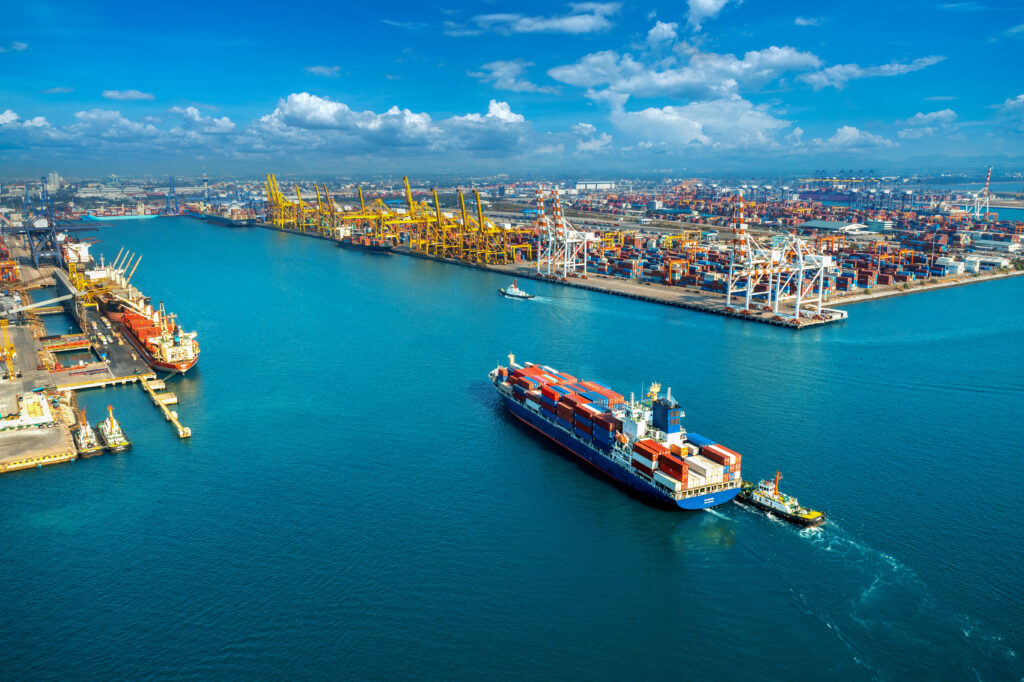
The Trump Administration is clearly hoping that the economic pressure of a blockade at the Strait of Hormuz will be as effective as warfare, at a lower cost. The U.S. Navy certainly has ample forces to enforce its blockade, and few ships are getting through.
While Gulf states brace for more attacks and Asia is exposed to challenging energy supply shocks, Europe seems better situated to avoid severe pain. But the EU remains unhappy with U.S. actions.
Qorvis analysts offer insights on current developments and long-term trends.
The blockade’s effect on negotiations
Ian Dollar, Analyst, Dubai
The ongoing closure of the Strait of Hormuz is turning the old adage on its head by proving a blockade is the continuation of war by other means.
The nine-day-old cease-fire between the United States and Israel, on the one hand, and Iran on the other, has grounded the planes, missiles, and drones that have defined this conflict. But they have done little to wrench free the logjam of ships and energy supplies that have been choked off from exiting the Gulf and reaching global markets.
Friday morning’s early announcement by the Iranian foreign minister of an “open Hormuz” followed by President Donald Trump’s social media posts that talks would resume may indicate a sudden opening is in the offing. But until proven, we must analyze the utility and market effect of the U.S. effort to employ a blockade to shape any negotiated resolution.
The blockade entails choking off Iran’s oil exports, which account for 70 percent of its government revenue. Such action is as threatening as U.S. bombing for a regime whose current troubles started with its inability to peacefully quell protests related to its plunging currency and worsening economy. And that is precisely why Trump is turning the economic screws.
Will it work? Unclear. Tehran has demonstrated its high tolerance for pain if it sees its existence imperiled.
Will it backfire? Also unclear. If neither Iran nor the Gulf can export energy, the U.S. will have to contend with angry East Asian allies, Europe chafing under high gas prices, and struggling partners in South Asia.
These may seem like second-order questions for the U.S. while it is trying to conclude an armed conflict. But the longer the blockade persists, the more isolated Washington may become. And that may have ramifications far from the narrow strait that is now the center of global politics.
U.S. Navy highly prepared
Tom Sharpe, Senior Advisor, London:
The U.S. Navy is highly prepared for the blockade, having deployed significant forces including the USS Lincoln carrier strike group, multiple destroyers, and amphibious ships from the 5th Fleet to patrol the Gulf of Oman. So far, multiple ships have been turned around by being warned; the US Navy hasn’t needed to board-and-seize anything yet: the threat of doing so has been enough.
The US Navy tracks vessels with deactivated transponders through multiple layers of intelligence, surveillance and reconnaissance assets such as satellites, radar, infrared, electronic emissions, radio intercepts and so on. Automatic Identification System (AIS) is only a helpful aid in this environment, and ships using deceptive practices like disabling AIS will actually stand out more.
U.S. naval presence in the Gulf substantially exceeds that of China and Russia. However, what happens if a Chinese flagged ship tries to run the blockade remains to be seen. Likewise, what if one of the three Chinese destroyers there was to escort a tanker through the Strait. Both these events carry a substantial risk of escalation and/or miscalculation.
UAE loses luster due to new risks
Noe Boggan, Analyst, Dubai:
The U.S. blockade in the Strait of Hormuz could trigger an Iranian retaliation against Gulf states, which have already sustained more than 5,787 aerial attacks, according to NBC. Saudi Arabia is urging Washington to halt the blockade out of fear that Iran will close the Bab al-Mandeb Strait, a Red Sea chokepoint controlled by the Houthis in Yemen.
This route has served as a crucial alternative for Saudi Arabia’s crude oil exports during the war. The UAE, meanwhile, has redirected its crude oil exports through the Fujairah pipeline. These two bypasses have partially offset disruptions in the Hormuz, becoming the world’s critical lifeline of energy supply.
At any given moment, Iran could close the waterway in the Red Sea, disrupt ports in the Persian Gulf and the Gulf of Oman, or target the Fujairah terminal, as they already did in March. Hence, Saudi Arabia’s concerns are very real.
Gulf states are in favor of diplomacy, but it’s not simple. The UAE and Bahrain helped craft the United Nations’ proposal calling for a safe maritime corridor, which Iran rejected. The outcome of this war determines the control of the region’s vital trade routes, forcing the GCC states to carefully strategize in order to ensure their own security.
Hormuz blockade likely to test Asian resilience
Benoît Lioud, Managing Director, Qorvis Geneva
A blockade of the Strait of Hormuz constitutes a systemic stress test for global supply chains and economic stability, not merely a short-term oil shock. Asia is especially exposed, given its heavy reliance on Hormuz-linked crude and LNG flows. Even with strategic reserves helping to cushion the immediate blow, a prolonged disruption would raise production costs across manufacturing, pressure inflation, and force governments and companies to accelerate energy diversification and rerouting strategies.
The impact extends well beyond energy. As shipping routes are diverted and inventories tighten, prices will rise for a wide range of inputs, including petrochemicals, fertilizers, metals, and food-related goods. That squeezes margins, weakens consumer purchasing power, and amplifies inflationary pressure across multiple economies.
The longer-term effect may be structural. A sustained crisis would likely reinforce regionalization, redundancy, and supply chain diversification as companies and policymakers seek to reduce exposure to geopolitical chokepoints. In this environment, agility and strategic foresight are key differentiators between resilience and vulnerability.
EU disappointed, but unlikely to take further action
Daniel Rocha, Partner, Brussels
The EU will continue to denounce any escalation, but not to the point of breaking with the U.S. Despite recent disagreements, the EU as a bloc still believes in a strategic partnership with the United States that predates and will outlast any specific presidency.
This creates a difficult balance, as the current U.S. administration is inviting greater engagement in the Middle East, for which there is absolutely no appetite in the EU. However, the response from the EU is consistent with its reaction to other situations perceived as crises, such as the threat of tariffs, the suspension of U.S. aid to Ukraine, or the rhetoric regarding Greenland.
The EU is under less pressure for direct engagement than the United States, as specific measures to mitigate the impact of an energy shock have been in place since COVID and the 2022 detachment from Russian oil. Most importantly, energy prices in Europe are less directly tied to the electability of policymakers than in the U.S.
That said, the EU’s relationship with the United States extends far beyond these factors and will remain strategically relevant for both sides.