
By J.P. Carroll
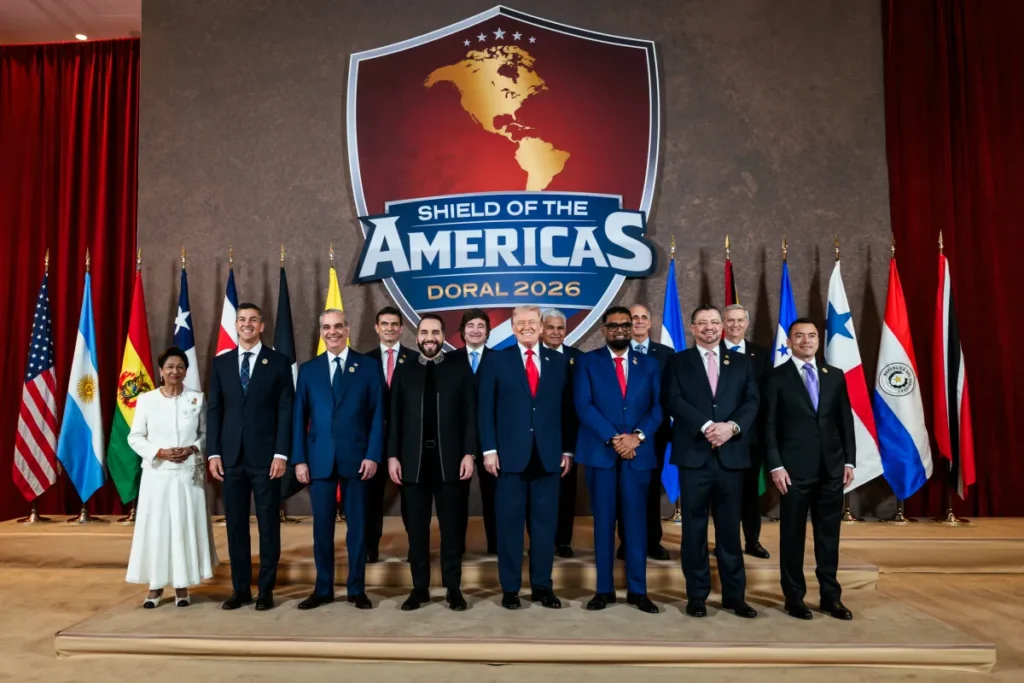
Over the weekend, President Trump hosted the Shield of the Americas Summit in Florida. Here’s what you need to know from the Summit:
Reinforcing partnerships
Leaders from Argentina, Bolivia, Chile, Costa Rica, the Dominican Republic, Ecuador, El Salvador, Guyana, Honduras, Panama, Paraguay, and Trinidad and Tobago attended the summit. Notably not in attendance was Mexican President Claudia Sheinbaum.
The Shield of the Americas Summit focused on improving coordination between the United States and Latin American partners to better counter cartels. This summit comes on the heels of Mexican authorities having found and killed Jalisco New Generation Cartel (CJNG) leader Nemesio Oseguera Cervantes, known as “El Mencho,” reportedly thanks in part to intelligence provided by the U.S. Central Intelligence Agency.
Besides the absence of Mexican leadership at the Summit, Colombian President Gustavo Petro was also absent. Petro and Trump have recently had tense exchanges in public, so while on some level this is not surprising, Colombia has long been a key U.S. partner in countering drug trafficking.
The leaders in attendance signed onto a proclamation, stating, “a commitment to using lethal military force to destroy the sinister cartels and terrorist networks.” This commitment marks the formalization of a new era in U.S. foreign policy in the Western Hemisphere, with an emphasis on U.S. regional security goals supporting U.S. economic policy.
Post-Maduro Venezuela and Cuba
This is President Trump’s first major gathering exclusively with Latin American leaders since the capture of Nicolas Maduro in January. Trump went on to praise Venezuela’s acting President Delcy Rodriguez, saying, “She’s doing a great job because she’s working with us.”
In the aftermath of Maduro’s ouster, many Cuban-Americans are hoping to see the Trump administration take action against the regime of Miguel Díaz-Canel next. Looking ahead to the midterm elections, the Cuban-American vote – particularly in South Florida – has been a dependable and important constituency for Republicans in President Trump and Secretary of State Marco Rubio’s home state.
According to Trump, the Cuban regime is, “at the end of the line.” Ultimately, a U.S.-led ouster of the Cuban regime would be in alignment with longstanding Republican foreign policy goals. Furthermore, the Venezuelan and Cuban regimes have long been viewed as interdependent.
U.S.-Ecuador Cooperation
U.S. military forces are now working with their Ecuadorian counterparts to counter narco-terrorist organizations in Ecuador. This new military cooperation was announced just days before the Shield of the Americas Summit, and has been welcomed by Ecuadorian President Daniel Noboa.
The newly-announced cooperation between the United States and Ecuador is reminiscent of U.S.-Colombian cooperation from 2000 to 2015 under Plan Colombia. U.S.-Colombian cooperation was key to weakening the Revolutionary Armed Forces of Colombia (FARC), and bringing them to the negotiating table.
It is too early to tell, but it seems that U.S.-Ecuador cooperation aims to similarly help the Ecuadorian government push back against drug trafficking and reassert control. The outcome of U.S.-Ecuadorian military cooperation may prove to be a model for similar operations across the region in the wake of this Shield of the Americas Summit.
Hemispheric Dominance
It is clear since the announcement of the U.S. National Security Strategy last year, that President Trump has sought to make U.S. influence in the Western Hemisphere clear. This Summit, organized by the Trump administration serves to make clear U.S. expectations for its regional neighbors when it comes to managing their security affairs.
Looking ahead, it remains to be seen how successful U.S. military activities will be in the region. For now, all eyes are on Cuba, waiting to see if the Trump administration opts for a Venezuela-style deal with elements of the current regime, or if a military option more like U.S. involvement in Iran is the end result.