

As the U.S. and Israeli campaign against Iran widens in scope to include more countries across the Middle East and beyond, Qorvis intelligence experts around the globe are tracking how rapidly changing developments impact global security and international trade.
Mediation appears to be a longshot right now
Brad Klapper, Chief Intelligence Officer, Washington, D.C.
The big question circulating Washington today for security analysts and energy/commodity market participants: What are the chances for a back-channel deal to end the war with Iran? On Wednesday, we saw a New York Times report of Iranian-U.S. communication soften some of the price spikes over the last week. But the report was thin on specifics and raised more questions than answers.
Does the Iranian faction conducting outreach exert actual control? Is the mediation bid authorized by anyone who does? Is this wish-casting from war-weary U.S. allies in the Middle East? Or an Israel effort to head off the potential for a “regime change light” scenario akin to Venezuela?
From our perspective, it is still too early to forecast a potential offramp through this (or any other) back channel. Neither the U.S. nor Israel has suggested they have reached mission objectives. Their costs, despite intensive media coverage, have been extremely limited. And Iran doesn’t seem able to make the necessary concessions or even stand up a negotiating team with the authority to make a deal. Our analysis is that the mediation odds right now are very low.
UK pulled into shifting from defense to offense; naval situation is key for Iran, Russia
Tom Sharpe, OBE, Senior Advisor, London
With war raging in Iran, the UK’s focus this week has been on whether our contribution should be offensive or defensive. An initially ambiguous stance on U.S. airbase use – “can neither confirm nor deny” – gave way to saying the U.S. “can use” the bases, but only after a drone struck RAF Akrotiri in Cyprus. The decision is also based on the understanding that these London dynamics are key to our post-war alliance with America.
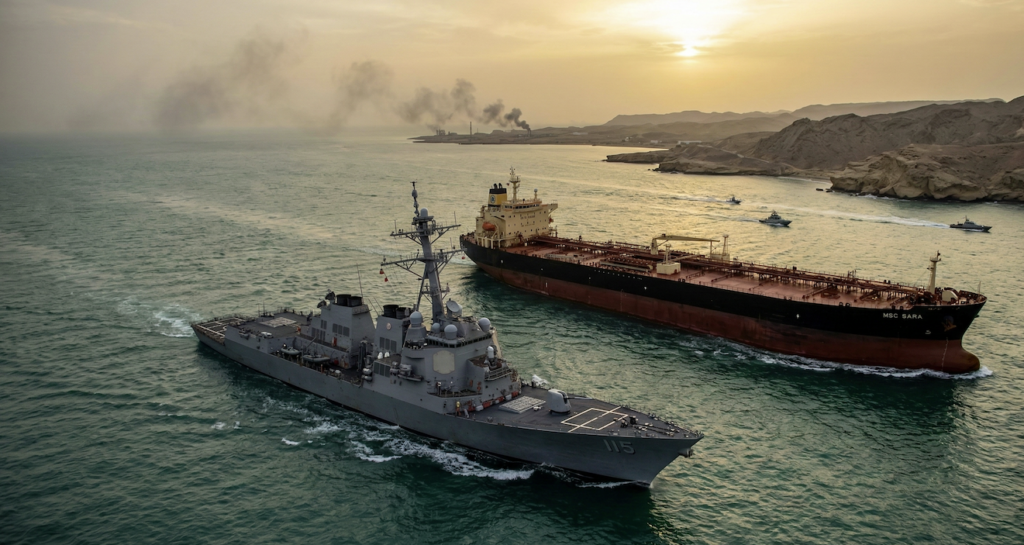
As a former naval officer, it’s vital to scan ahead no matter the chaos. While reporting in Iran focuses on the air war, missile exchanges, and the defeat of their regular Iranian navy as shaping activities, contacts on the ground are essential to determine “what next?” This includes analysis of remaining IRGC Navy capability vs. U.S. warships escorting tankers and restoring trade through the Strait of Hormuz.
Further afield, the Russian shadow fleet operates with impunity in UK waters despite tough rhetoric from the Home Office and Ministry of Defense, all we got was another sanctions list (on the war anniversary) and little else. Understanding this – and how it correlates with U.S. and EU activities – is key to defeating this Russian trade.
With oil price hikes relatively limited, Brussels remains calm on energy situation
Dan Rocha, Partner, Brussels
Despite the historic disruption around the Strait of Hormuz, oil prices have not yet spiked by nearly as much as would be expected for a disruption of this magnitude. While Gulf loadings are temporarily on hold, there are still significant oil inventories available outside the Middle East. The UK’s Brent benchmark is trading at about $80/barrel and the U.S.’ West Texas Intermediate only around $73.
Here in Brussels, the EU Commission told the member states’ energy coordination groups that they see no immediate risks to the security of supply. We also spoke to several traders who noted that European refiners appear well covered for March, with meaningful prompt supply still available in the North Sea and Mediterranean.
Part of the perceived tightness is behavioral, with some physical holders withholding barrels rather than showing the prompt availability, mostly in hopes of the disruption lasting longer and prices going further up.
Iran as isolated as it’s ever been since 1979
Ian Dollar, Analyst, Dubai
Globally isolated even before the U.S. and Israel began attacking on Feb. 28, Iran is in its weakest position since the current form of government took power in 1979. With strategic partner Russia largely absorbed by its ongoing war in Ukraine, China cautious about the extent of its involvement, and Iran itself having killed tens of thousands of anti-regime demonstrators earlier this year to maintain control, Iran finds itself isolated while under attack by the most sophisticated armed forces in the world.
Iran’s move to close the Strait of Hormuz, as well as its attacks on Gulf nations, Cyprus, and Turkey signal the existential desperation of the remaining elements of the Iranian regime and further its isolation from its regional neighbors.
Crude prices have jumped approximately $10/barrel in the past week and promise to increase the longer that the Strait of Hormuz remains impassable. News of initiatives such as naval escorts through the Strait or peace talks will only have limited bearish impact until measurable action occurs on these fronts.
Watching for an impact on midterms
J.P. Carroll, Senior Advisor, Washington, D.C.
It remains to be seen what – if any – the impact of the war in Iran will be on the U.S. midterm elections. Historically, midterm elections have more to do with how voters feel about the economy and they tend to function as a referendum on how voters feel about the sitting U.S. president.
The last time a U.S. midterm election was significantly influenced by voter concerns over foreign policy were the 2006 U.S. midterm elections during George W. Bush’s Iraq War. After those elections, Democrats took control of both the U.S. House of Representatives and the U.S. Senate. Notably, then-U.S. Secretary of Defense Donald Rumsfeld resigned from office in December. While the midterm elections were never publicly stated as the reason for Rumsfeld’s resignation, it was widely understood that he had become the face of unpopular war efforts.
It is clear that the Trump administration is mindful of the 2006 midterm elections, and they do not want a repeat of this. The longer the Iran conflict goes on, the greater the chances it results in negative electoral outcomes for the Republicans this fall.